There are no items in your cart
Add More
Add More
| Item Details | Price | ||
|---|---|---|---|

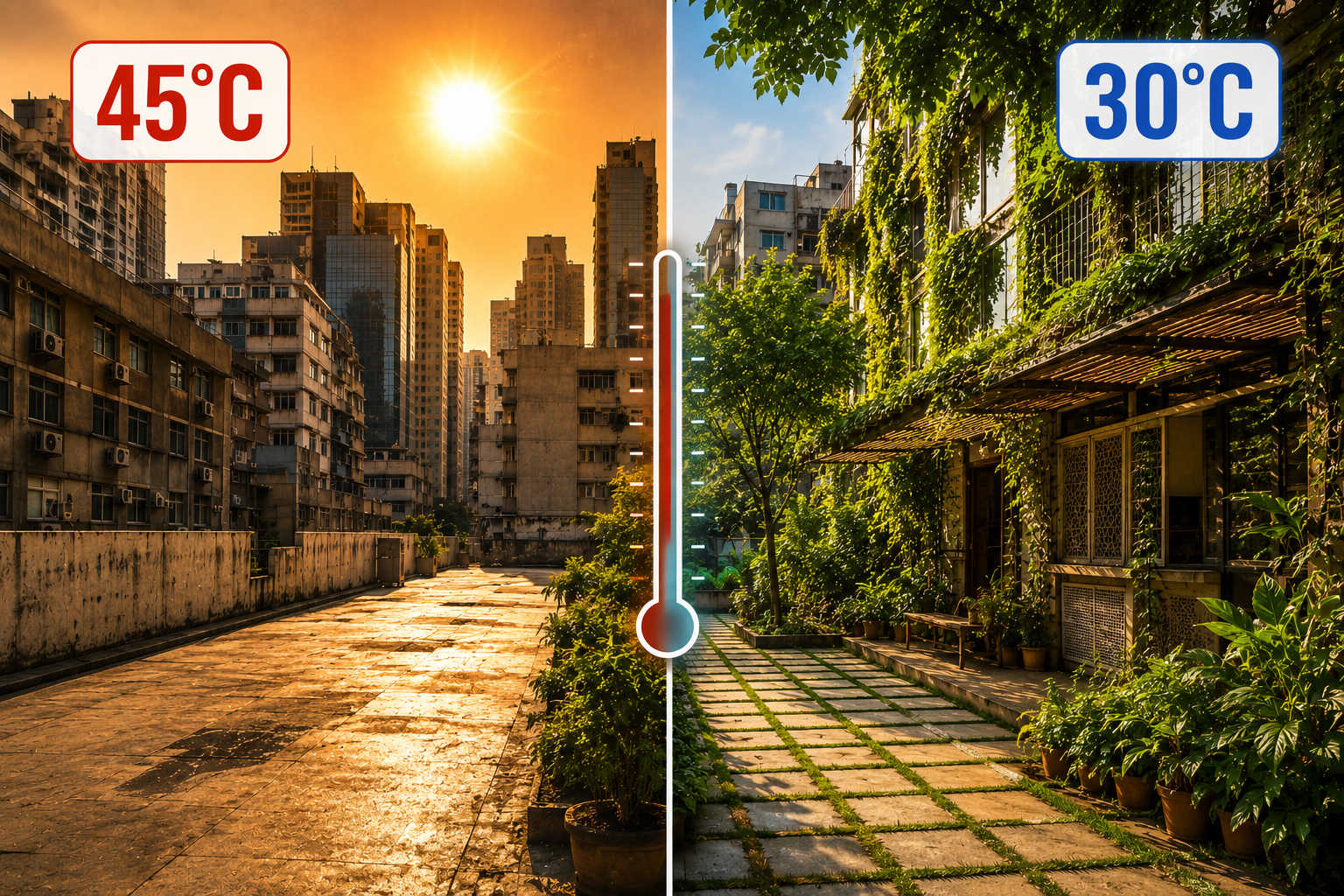
As suffocating temperatures become the "new normal" in Indian mega-cities, our immediate reaction is often to turn up the air conditioning. However, this mechanical solution comes with a hidden cost: while it cools our interiors, it dumps waste heat into the streets, contributing to a vicious cycle where cities become measurably hotter than rural areas. This Urban Heat Island (UHI) effect is often less about the sun and more about how we have built our "heat trap" cities using glass, concrete, and asphalt.
Drawing on permaculture thinking which encourages us to observe and interact with natural patterns rather than working against them. Here are eight ways to keep your home naturally cool this summer.
1. Plant "Natural Air Conditioners
The most effective cooling strategy is to treat trees as vital infrastructure. Strategically placing dense-canopy, evergreen trees like Neem or the Umbrella Tree around your home provides immediate shade and cools the air through evapotranspiration. Studies show these living coolers can lower surface temperatures by up to 4.8°C and ground temperatures by as much as 5.1°C.
2. Adopt High-Albedo Surfaces with Cow Dung Paint
In line with the principle of producing no waste, you can apply nature-inspired coatings to your roof. Cow dung-based paint (often referred to as prakritik paint) is a renewable, VOC-free option that provides thermal insulation. Field trials in India have shown it can reduce roof temperatures by 3–5°C, cutting indoor energy demand by up to 15%.
3. Design for Natural Airflow (Jaalis and Courtyards)
Modern glass box high-rises trap heat. Instead, we should return to vernacular architecture** that utilizes jaalis (perforated screens) and central courtyards. These features encourage natural cross-ventilation and allow hot air to rise and escape through vents, maintaining thermal comfort even in humid conditions.
4. Integrate Blue-Green Buffers and Baolis
Permaculture emphasizes catching and storing energy; in an urban context, this means managing water to regulate microclimates. Reviving traditional baolis (stepwells) or restoring small urban wetlands creates a "blue-green" buffer. These spaces use evaporative cooling to keep local areas significantly cooler than nearby pukka (built-up) areas.
5. Embrace "Kaushi Kheti" (Green Roofs)
If you have a flat concrete roof, it is likely absorbing heat all day. Installing a green roof, locally known in the region as “kaushi kheti”, acts as a layer of "living insulation". Vegetation on the roof can reduce the temperature of the building's "skin" by as much as approx 15°C.
6. Swap Concrete for Permeable Surfaces
Hard, grey surfaces like asphalt and concrete act as heat traps that release warmth long into the night. By replacing concrete driveways or paths with permeable pavements or ground-cover vegetation, you allow rainwater to nourish the soil and prevent your surroundings from contributing to the UHI effect.
7. Return to High-Thermal Mass Materials
Steel and concrete structures heat up quickly. Regenerative design suggests using local materials like compressed earth blocks, timber, or sandstone. These materials have high thermal mass, meaning they absorb heat during the day and release it slowly at night, keeping your indoor environment stable.
8. Utilize Deep Verandahs and Shading
Observation shows that shielding a structure from direct sunlight is half the battle. Traditional designs incorporate deep verandahs and overhanging sloped roofs to ensure that windows and walls remain in the shade during the peak of the day, significantly reducing solar heat gain.
Conclusion
The heat we experience in our cities is not just a climatic event; it is often a design failure. By shifting from energy-intensive mechanical cooling to these simple regenerative shifts, we can create homes that breathe with nature. It is time to move beyond "green ornamentation" and start designing cities that serve as resilient, self-cooling ecosystems.
Learn More
If you would like to explore how these ideas come together into a practical, step-by-step system, you can learn more here: 👉 Explore the Permaculture Design Course
If you are looking to apply these principles at a larger scale, whether for land, institutions or sustainability initiatives, you can reach out here: 👉 Start a Conversation